


Self-leveling Application Tips: Keys to Successful Installation
- Interior Floor Designs
- Feb 26
- 4 min read
Benefits of Self-Leveling: A Comprehensive Guide for Homeowners
Self-leveling can be an all-in-one solution for issues that impact floor installation. In an ideal world, every floor would be perfectly flat—but that’s rarely the case. If you are new to using self-leveling products, there are some key things to consider for a successful installation.

When Should Self-Leveling Be Used?
Self-leveling is especially well-suited for existing concrete slabs. In older homes, floors are rarely flat. They often have peaks and valleys that limit flooring options. Self-leveling can also be a cost-effective solution when removing existing flooring is difficult or when encapsulation is preferred.
Keys to Success
Preparation is everything. The bond strength between the leveling product and the substrate is critical to the longevity of the entire project. Using the wrong leveler or primer—or skipping a step—can lead to failure. The installation may look fine at first, but over time, the product can release from the subfloor. This can lead to cracking, shrinking, or warping, affecting anything installed on top. Such issues can result in costly repairs or the need to redo the project from the ground up. Follow these self-leveling application tips that are often overlooked to achieve a successful installation.

What Type of Leveler Should You Use?
Most self-leveling products are cement-based, and each has specific uses. The main differences are curing time, strength, flow/spread-ability, and wear resistance. Most products are approved for use over concrete, and some are approved for use over wood. Because all structures expand and contract with temperature and humidity changes, selecting the correct product is crucial.
Cementitious
Higher-density modified concrete for use over structurally stable surfaces like concrete and tile. Suitable for most below-grade applications.
Fiber-Reinforced
Contains fiberglass to improve stability and is commonly used over wood or subfloors that are damaged or cracked. Fibers may be pre-mixed during manufacturing or added during mixing.
Gypsum-Based
Lightweight underlayment for use over plywood and acoustic gypcrete commonly found in multi-story condos or apartment buildings. Can also be used to encapsulate existing flooring materials, including VCT, that may contain asbestos (follow all applicable regulations).
Surface Preparation
All surfaces must be clean, dry, and stable. This includes testing humidity and pH. Surface porosity also affects which primer you should use. A simple test is to place a few drops of water on the floor and observe whether it absorbs or puddles. Keep in mind that not all concrete or wood is porous—test before you choose a primer.
Self-leveler will flow anywhere it’s allowed to, which can create defects and messes. Fill cracks and seams before priming. Seal gaps under walls or cabinets, and dam doorways to prevent the leveler from spilling into adjacent areas.
Pro Tip
Expansion joints are required at all vertical surfaces. Self-adhesive foam expansion tape should be installed around the entire perimeter. It also acts as a dam to keep the leveler where you want it.

Selecting the Right Primer
Primer acts as the bond between the subfloor and the leveler. It can also affect flow rate and working time. It seals dust and limits moisture absorption that could alter curing. When going over existing flooring materials, choose a primer designed for that surface to ensure proper adhesion.
Most manufacturers offer primers for:
Porous floors (exposed concrete and wood)
Nonporous floors (tile, vinyl, VCT, or surfaces with adhesive residue)
Gypsum-based concrete (common in condos or apartments)
Epoxy primer (enhanced bond strength and/or moisture mitigation)

Staging Materials
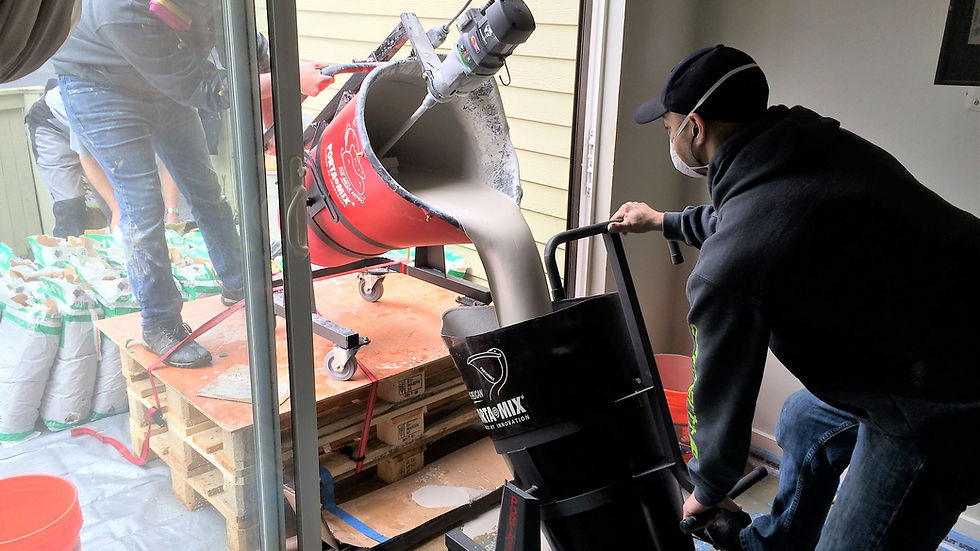
Whenever possible, leveling should be done in one continuous pour. Make sure all tools and materials are ready, and you have easy access to water. Working time is limited, so complete all surface preparation before you begin mixing. Mixed leveler can be heavy and difficult to transport. Wheeled mixing carts and ramps can help move material efficiently.
Mixing
Always follow the manufacturer’s instructions closely. Use a mechanical mixer and the correct mixing paddle. One of the most common mistakes is over-watering. Too much water can separate bonding agents from the mix and severely reduce strength. Once cured, an over-watered pour may look uneven and feel chalky—and the installation may be compromised.
Pro Tip
Figure out how much you can mix at one time and the exact water volume needed for each batch. Pre-measure that amount into a 5-gallon bucket and mark the water level. Create an opening just above the water level using a hole saw so that excess water can easily flow out. This will save time and ensure that every batch is consistent.

Applying the Leveler
Self-leveling is rarely a one-person job because working time is a limiting factor. A typical installation uses 2–3 people: one spreading the material, one mixing continuous batches, and one handling transport, cleanup, and support. With the right tools, achieving a flat surface is much easier.
Pro Tip
Plastic depth posts can help you hit the desired thickness. Set them at intervals and cut them to the required height with the assistance of a laser level. Always meet the manufacturer’s minimum thickness requirements.

Curing Times
There’s a difference between the leveler being set and being fully cured. Even rapid-setting products may not be ready for floor covering within the advertised time frame—especially over nonporous materials like vinyl that act as a vapor barrier. When in doubt, wait longer.
Most products also have a maximum depth per application. Anything beyond that may require multiple pours. Allow each layer to dry completely and prime the surface again before applying the next layer.
Pro Tip
If you don’t have a moisture meter, place a scrap of flooring on the leveler for an hour. If moisture is visible when you remove it, the leveler isn’t ready.
Safety First
Always follow the safety precautions listed by the manufacturer. Self-leveling compounds can contain Portland cement, silica, and fiberglass, requiring safety measures to avoid skin/eye irritation and respiratory issues. Essential precautions include wearing a dust mask to avoid inhalation, alkali-resistant gloves, eye protection, and long-sleeved clothing. Ensure you have adequate ventilation, and only mix with approved products.
Conclusion
Self-levelers do a lot of the work for you, but the results depend on proper prep, priming, mixing, and curing. Missing one key step can leave you with a surface that isn’t suitable for most flooring installations. Because the material volume can be significant, leveling can be an expensive project—so it pays to do it right the first time.
Need help? Consider contacting a professional. We offer leveling and floor repair services for concrete and wood-framed or raised foundations. For more information, visit Interior Floor Designs.


Comments